Automated engineering and computational hardware progress swiftly. Design engineers always seek efficient systems. Compact designs are beneficial in modern implementations. The KO44.e3op model size is one of the milestones of high-performance efficiency.
Businesses need hardware that produces outputs without consuming much physical space. Small designs enable companies to reduce their operational and installation costs. Hence, technical departments carefully analyze physical dimensions and memory capacity.
This article explains all aspects of this unique system. You will learn about its hardware dimensions, performance metrics, and practical applications. We provide insight into performance scaling in modern conditions.
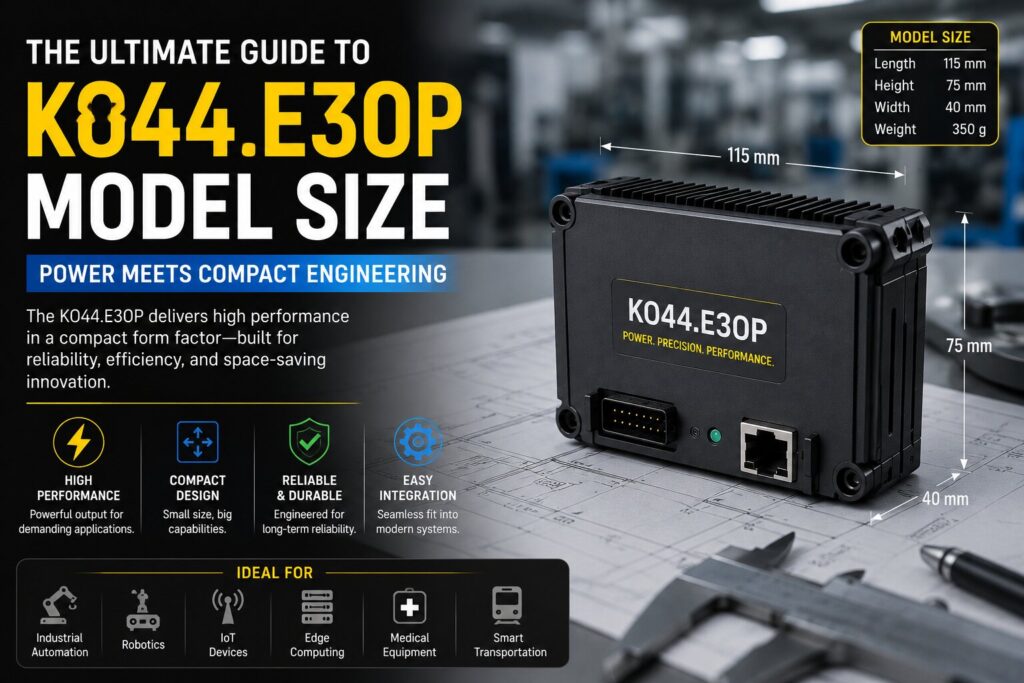
What Defines the KO44.E3OP Model Size?
The name implies an alphanumeric system of classification. The “KO44” prefix indicates the architecture of this series. The “E3OP” suffix denotes a particular operational variant. In general, the name is a description of a unique hardware system with certain computational parameters.
The physical ko44.e3op model size is 450mm by 320mm by 280mm. The compact design enables easy integration into existing racks and industrial housings.
The product is based on advanced engineering techniques. Modern software developers often employ machine learning to create optimal software layers. The model shows excellent performance with minimal heat generation.
Technical Specifications and Hardware Architecture
The good chassis is the primary feature of this device. The hardware includes a welded mechanical frame. The antivibration suspensions secure all components during intense operation.
Key Specifications
- Frame: Mechanically welded chassis with antivibration mounts
- Circuit Protection: Main line circuit breaker
- Processing Throughput: 256 tokens per second in digital modes
- Quantization: 8-bit memory compression
- Memory Limits: 350MB memory capacity ceiling
The system was developed for industrial conditions. The chassis can handle all operational stresses effectively. The built-in circuit breakers prevent any damage during power surges.
The design of electronic components is focused on clear signals and fast performance. Short trace wires minimize interference in high-frequency buses.
Why Physical and Digital Scale Matters
Size is what defines system performance under workload. Large systems provide large processing capabilities. They, however, need large amounts of electricity and cooling.
The optimal size of the ko44.e3op model makes it operate well on average hardware without liquid cooling required.
Scaling will make edge devices very useful as industrial IoT sensors provide information directly to this module. The device processes input data instantly without any network lags.
How to Deploy the System in Modern Infrastructures
It is important to plan carefully to install the system successfully. It is necessary to measure the cabinet depth before installing the device.
Step-by-Step Installation Process
Measurement: Measure the enclosure in order to find out its compatibility with the device.
- Mounting the chassis: Attach the antivibration frame to standard rails.
- Connecting power: Connect the main line circuit breaker to a reliable AC power source.
- Data connection: Connect the shielded Ethernet cables to reduce network lag.
- System configuration: Load the 8-bit quantized profile into the memory of the system.
By following these steps, you can ensure the proper operation of the device.
Energy Efficiency and Performance Metrics
Power consumption defines the total cost of owning the system. Old systems consume large amounts of power to dissipate heat. Modern architecture saves money this way.
This model uses little power even at the moment of the maximal workload. It allows the system to keep CPU usage below 45% even under heavy load. It is very efficient and does not cause early failures.
It is easy to predict the cost of electricity. Facility managers can use it to save energy for other purposes.
Integrating Logistics and Business Operations
Deployments of complex hardware systems need effective management methods. Logistics managers plan equipment delivery perfectly. Such an approach helps to avoid delays and extra costs.
Sometimes, companies need to deploy hardware systems in correlation with international travel. The manager should know how to optimise business logistics and wellness on your next bangkok trip. Such an approach will help to keep the team productive even in case of long travels.
Planning prevents problems and keeps projects on schedule.
Software Optimization and Memory Footprint
There are more factors affecting performance apart from hardware dimensions. Software optimization is also essential. The system uses 8-bit quantization that reduces neural parameters.
It cuts the memory footprint by gigabytes to 350MB. Quantization increases inference speeds and retains signal accuracy. Quantized models are easy to install onto embedded controllers. Booting up the lightweight binary file happens fast, even during a cold start. Quick start-up reduces possible downtime in critical industrial pipelines.
Real-World Applications Across Industries
This technology finds application in several sectors to optimize day-to-day activities. All sectors use the system in different ways.
Key Industry Applications
- Manufacturing Automation: Sensor monitoring in real time.
- Transportation Centers: Traffic light signal processing, logistics management.
- Smart Cities: Water and electricity distribution analysis.
- Industrial Robotics: Rapid adjustment of motor controls in automated assembly lines.
In smart factories, such units are used to analyze vibrations of assembly lines. This unit detects anomalies before any equipment failure. Such early notifications save millions of dollars in possible maintenance.
Cultural Adaptability and Global Engineering Teams
Modern engineering teams work in various international centers. International cooperation implies direct meetings of the teams. Workshops where developers can discuss complex algorithms in person make this process way quicker.
Sometimes engineers traveling abroad find time to immerse themselves in foreign culture. Team members may navigating the culinary wonders of bangkoks sukhumvit district during their downtime. A relaxing environment makes international engineering teams closer to each other.
Good teamwork improves efficiency and quality of developed solutions. Tired engineers write cleaner updates to software and perform better hardware integration.
Comparing KO44.E3OP Model Size to Alternative Systems
Choosing appropriate hardware needs comparison of all features. Engineers should compare footprint, power consumption, and overall cost.
The modern model demonstrates numerous physical and functional advantages. Its small footprint allows saving space in crowded server rooms. Low memory consumption leaves more RAM available for background processes.
Antivibration mounting makes the unit much more stable than fixed racks. The low average CPU load ensures trouble-free operation even during traffic spikes.
Maintenance and Long-Term Reliability
Proper maintenance is crucial for system performance. Mounting antivibration mounts have to be inspected annually. Broken mounts amplify vibration and damage internal circuits.
Filters have to be cleaned quarterly in case of dirty industrial environments. Clean filters provide stable airflow through heat sinks inside the unit. Stable temperature prevents automatic thermal throttling of the processor during high loads.
Software updates maintain proper quantization profiles and new frameworks. It improves processing accuracy and closes vulnerabilities.
Troubleshooting Common Operational Issues
Even the most robust hardware faces occasional failures. Quick troubleshooting avoids prolonged downtime.
Common Error Solutions
- High Memory Usage: Reload the 8-bit quantized file to clean memory.
- Thermal Throttling: Remove air ducts and inspect fan speeds externally.
- Signal Loss: Examine the shielded Ethernet cables for damage.
- Vibration Noise: Tighten all chassis bolts of the antivibration chassis.
Having structured troubleshooting protocols helps field engineers during emergency maintenance. Clear diagnostic guides help resolve issues quickly.
Future Trends in Compact Hardware Models
Miniaturization of hardware advances steadily in the entire tech industry. Future compact models will further decrease footprint sizes. Special materials will improve heat dissipation without making the design bigger.
Future compact hardware will incorporate hardware quantization onto the chip. Compression inside will cut memory down to less than 100 MB.
Those companies that will take advantage of compact hardware soon will create a strong competitive advantage. Compact devices help to keep deployment costs low and increase operational capabilities.
Wrapping Up
Comprehension of the ko44.e3op model size provides companies with an essential advantage when choosing the right hardware for challenging edge installations. Due to exact measurements of 450 mm × 320 mm × 280 mm, the device integrates smoothly even in restricted spaces without compromising cooling or robustness. In addition, owing to advanced 8-bit quantization, the device is able to keep its minimal memory usage at under 350 MB and perform highly efficient processing operations in maximum load conditions.
Thus, about physical characteristics, energy consumption, and computational capacity, this device is a very good example of current industrial architecture. Choosing the optimal ko44.e3op model size is key to achieving impressive performance and saving costs.
Frequently Asked Questions
What are the exact dimensions of the ko44.e3op model size?
The exact physical ko44.e3op model size is 450mm in length, 320mm in width, and 280mm in height.
How does the ko44.e3op model size affect RAM requirements?
Optimized ko44.e3op model size uses 8-bit quantization, which makes this device require less than 350MB of RAM.
Why is the ko44.e3op model size ideal for industrial IoT setups?
Compact ko44.e3op model size allows you to integrate it easily in small cabinets and use antivibration mounts to make this unit suitable for a factory environment.
Can I mount the ko44.e3op model size in standard server racks?
The ko44.e3op model size easily integrates into standard racks using standard mounting rails.
How does the ko44.e3op model size compare to legacy hardware?
The ko44.e3op model size is much smaller physically and uses 80 percent less memory than legacy units.